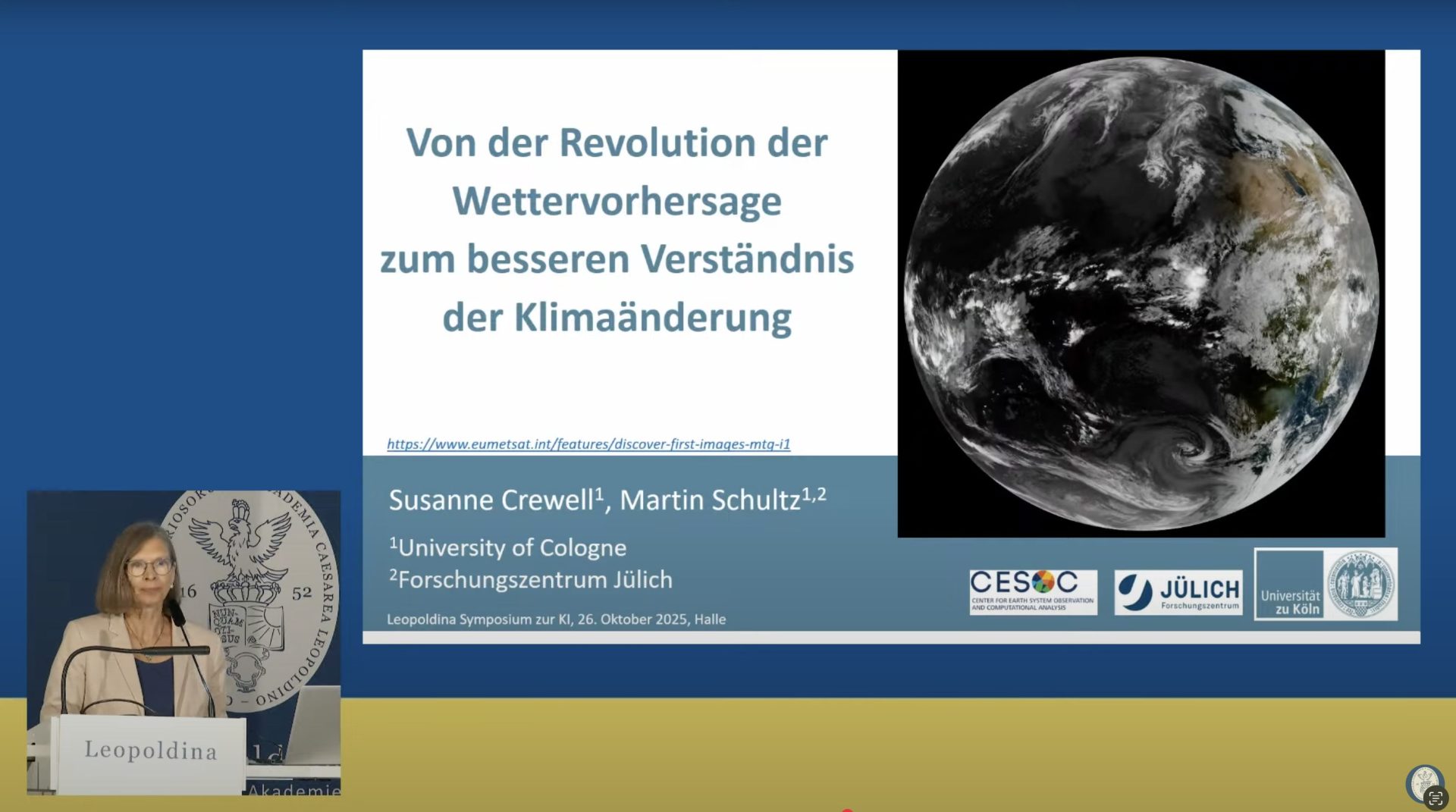
Each snowflake is different, each cloud is different. This means we cannot understand our system with very simple models. We, as meteorologists or remote sensing experts, already used neural networks early on to figure out how to translate what a satellite measures into physical quantities (retrieval phenomenon). Neural networks were abandoned in the 1990s because they sometimes produced errors. But in terms of robustness, a lot has changed since then!
With this reflection, Susanne, Director of CESOC, opened her invited lecture at last week’s Annual Assembly of the German National Academy of Sciences Leopoldina. Her talk, developed together with Martin Schultz, carried the title: “From the revolution of weather forecasting to a better understanding of climate change.”
The Leopoldina, founded in 1652, is one of the world’s oldest academies and Germany’s National Academy of Sciences. Its Annual Assembly gathers leading experts across disciplines to discuss key challenges of our time. This year, the focus was on artificial intelligence — its scientific advances, practical applications, and societal implications. From breakthroughs in medicine and life sciences to earth and climate research, the discussions highlighted not only opportunities but also ethical questions and responsibilities that come with this powerful technology.
Watch the talk here.