STEP UP! Fellowships

The STEP UP! Fellowship Programme

The STEP UP! Fellowship Programme strengthens joint research between CESOC and ECMWF and is part of Germany’s offer to support ECMWF’s Bonn activities. It is coordinated by DWD, which also funds the positions and provides training in professional skills.

Fellows are jointly selected by ECMWF, CESOC, and DWD experts. They are appointed for two years (extendable to three if pursuing a PhD) and develop projects closely connected to CESOC activities such as CRC 172 Arctic Amplification, CRC 1502 DETECT, and the Jülich Observatory for Cloud Evolution (JOYCE). Our fellows pursue PhDs with CESOC members as official advisors, ensuring strong integration into the local research environment.

Since 2023, fellows have been working at the ECMWF site in Bonn, building bridges between ECMWF’s international research and CESOC’s scientific infrastructure. Their journey is marked by joint kick-off and mid-term events, featuring engagement with ECMWF executives, CESOC leadership, and representatives from DWD and BMV.

Research topics include digital twins, machine learning, the use of novel observations (GNSS-IR, EarthCare), and advances in land data assimilation (LDAS). Fellows thus contribute directly to next-generation Earth system modelling.

Our Second Cohort (2025)

While two fellows from the first cohort, Paolo Andreozzi and Luise Schulte, are in their third fellowship year aiming to complete their PhDs, in January 2025, the second cohort has begun with four fellows: Francesca Covella, Eleni Kalogeraki, Sandra Klewinghaus, and Kim Andreas Weiss.

Research Topics

ECMWF Supervisor: Jasper Denissen, Christoph Ruediger
Supervisor CESOC: Harrie-Jan Hendricks-Franssen (FZJ)

The purpose of Francesca’s project is to assess the impact of land data assimilation on river discharge and associated flood forecasting in the ECMWF land–hydrology system. To do this, Francesca will start by setting up and performing data denial and forecast experiments with the coupled ecLand–CaMa-Flood system to identify the impact of different observations, such as soil moisture or snow cover, and data assimilation on flood forecasting. Then the team will assess the experiment results against using in-situ river discharge observations. Another fundamental step will be to score and evaluate the impact of each land surface observation type. Communicating and documenting the results with the rest of the teams and the wider scientific communities will be paramount as many researchers are working on the development of CaMa-Flood and the ecLand model, and many user communities will benefit from these model improvements and associated flood forecasting.

ECMWF Supervisor: Esti Gascon
Supervisor CESOC: Vera Schemann (UoC) & Nikki Vercauteren (UoC)

Fellow Sandra Klewinghaus will evaluate case studies of extreme weather events using high-resolution simulations from the DestinE Extremes Digital Twin. The aim is to assess the accuracy of the forecasts by comparing them to observations and simulations from the Global-to-Regional-ICON project. To do so, they will apply methods for uncertainty quantification and develop new diagnostics. The long-term goal is to suggest and test potential improvements to the model and translate the global weather information into regional information useful for decision-making.

Before starting the Fellowship, Sandra  finished her Master’s at the TU Darmstadt in interdisciplinary Mathematics. She specialised in Numerics of partial differential equations and did my Master’s thesis in meteorology, extending the dynamical core of a LES model in terrain-following coordinates. Next to her studies she had several side jobs to apply her knowledge from Mathematics and Meteorology by developing e.g. a radar composite for Germany.

ECMWF Supervisor: Patricia de Rosnay & Pete Weston
Supervisor CESOC: Jürgen Kusche (UB) & Makan Karegar (UB)

Eleni’s project focuses on advancing the land data assimilation system by developing the assimilation of GNSS-R soil moisture data. The objective is to assess the impact on numerical weather prediction (NWP) by comparing it with existing soil moisture products used at ECMWF, such as SMOS and ASCAT. Key tasks include implementing GNSS-R data assimilation in the offline land system, conducting land data assimilation experiments and evaluating the influence on land surface conditions and weather forecasts. The expected outcomes include enhancing soil moisture representation in the land assimilation system, with the potential to enhance NWP accuracy. The comparative analysis between the existing datasets (SMOS, ASCAT) will assess the added value of GNSS-R data, and the findings of the project will be shared through technical reports, contributing to advancements in data assimilation techniques and operational forecasting capabilities at ECMWF.

ECMWF Supervisor: Mark Fielding
Supervisor CESOC: Uli Löhnert (UoC)

The aim of Kim’s project is to improve the current understanding of clouds and precipitation, and their representation in models. For this purpose, observational data from the Europewide ACTRIS-network, comprising ground-based radars and lidars, will be combined with the radar and lidar measurement devices of the EarthCARE satellite launched in May 2024.
This project seeks to gain new insights into/improve our knowledge of clouds and precipitation and their impacts within the atmosphere, and contribute to new developments of the microphysics scheme of the Integrated Forecasting System (IFS) and thereby to a better representation with regard to weather prediction and climate projections.

Our first Cohort (2023)

Within the framework of the STEP UP! Fellowship programme coordinated by the German Meteorological Service (DWD), four early career scientists started at the ECMWF site in Bonn between January and April 2023. Paolo Andreozzi, Katerina Anesiadou, Luise Schulte and Florentine Weber are working for initially two years on their respective projects in close contact with supervisors from ECMWF as well as mentors from CESOC. Through this bridge, CESOC will provide ECMWF and the fellows with links to local research infrastructures and large collaborative research projects. An article about the programme and the individual topics can be found in the ECMWF spring newsletter 2023.

Research Topics

ECMWF Supervisor: Richard Forbes, Linus Magnusson & Jonathan Day
Supervisor CESOC: Susanne Crewell (University of Cologne)

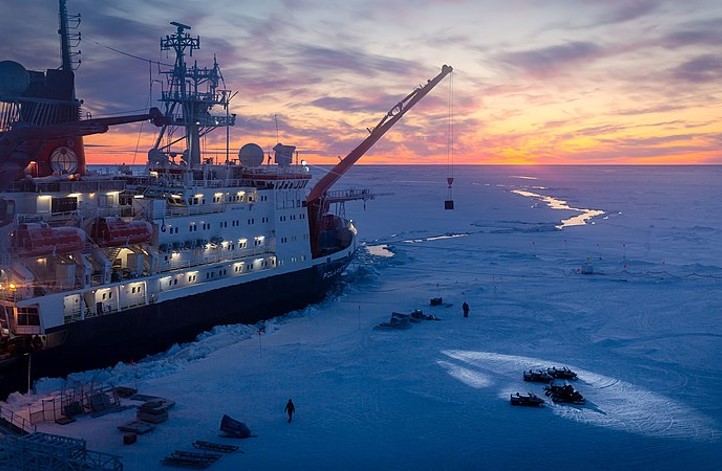
The Arctic is particularly sensitive to climate change, and clouds (especially liquid-containing clouds) play a key role in the Arctic climate system by emitting and reflecting radiation. Although improvements have been made in recent years, it is still difficult to represent Arctic mixed-phase clouds in numerical weather prediction (NWP) models. In this project, the representation of clouds in the ECMWF IFS model will be investigated using observational data from the exceptional one-year ice drift campaign MOSAiC (2019-2020). The goal is to further develop the model to improve the representation of clouds in the Arctic.

The project is carried out by Luise Schulte, who received her master’s degree in physics at Goethe University Frankfurt with a modelling case study of cloud edge effects of Arctic Mixed-phase clouds using the ICON model in the Atmospheric Physics and Climate Group.

The Polarstern in the Arctic during the MOSAiC campaign, by Stefan Hendricks.

ECMWF Supervisor: Gianpaolo Balsamo, Linus Magnusson

According to UN predicitons, two-thirds of the world’s population will be living in urban areas by 2025. This means that cities will play an increasingly important role in climate models and weather forecasts. However, the current representation of cities in these models is still not adequate. To address this challenge, our project focuses on high-resolution modelling of the regional water cycle and temperature in urbanised areas.

Our selected fellow, Florentine Weber, will investigate this topic in collaboration with the CESOC project Disentangling the Role of Land Use and Water Management (DETECT). With a PhD in climate physics from the Grantham Centre for Sustainable Futures and The University of Sheffield in the UK, Florentine has conducted research on the drying of the atmosphere over land. As a highly engaged member of the scientific community, she serves as a representative for early career researchers in the European Geosciences Union (EGU) Hydrological Science Division and a panel member for the Global Energy and Water Exchanges (GEWEX) program Hydrology (GHP). Florentine’s background in science communication makes her an asset to the German Physical Society (DPG), where she works as a project coordinator to support the organisation’s efforts.

The Rhine, passing through Bonn – with the ECMWF building on the west side.

ECMWF Supervisor: Sean Healy & Patricia de Rosnay
Supervisor CESOC: Jürgen Kusche (University of Bonn)

Satellite altimeters, currently used in ocean and wave data assimilation, provide global coverage of sea-surface height and ocean wave height. Beyond that, they could provide additional information on the atmospheric state. Until now, this information is treated as “corrections” and is not put to further use. Within this fellowship, the altimeter measurements will be incorporated in a coupled data assimilation system, by using the ground-based GNSS Zenith Total Delay assimilation methodology, in order to improve the exploitation of the available observations and investigate the potential of extracting atmospheric information.

Katerina is a physicist (Aristotle University of Thessaloniki, Greece) with a MSc in Environmental Physics (University of Bremen, Germany). After her studies she worked as a research assistant in a group of traffic engineers (Joint Research Centre, Italy) and recently completed a research fellowship related to the nowcasting of extreme weather events (University of Padua, Italy).

Sketch of altimeter measurement with satellites. Image: CNES/David Ducros, taken from spaceflight101.com.

ECMWF Supervisor: Robin Hogan & Richard Forbes
Supervisor CESOC: Birger Bohn (Research Centre Jülich) & Ulrich Löhnert (University of Cologne)

Aerosols and their composition are not only relevant for air quality but they also change radiation and initiate cloud formation. Thus, they play an important role for the climate. This project aims at improving the operational representation of prognostic aerosols keeping the computational costs as low as possible. By means of ECMWF’s Integrated Forecasting System including atmospheric composition (IFS-COMPO) the effects of day-to-day variations of two aerosol species on the forecast will be studied. CESOC will contribute with expertise on chemistry and observation of aerosols at the research facilities in Jülich.

Paolo Andreozzi started at the ECMWF in April having recently graduated at the University of Hamburg with a MSc thesis on the properties of Kelvin wave errors in the ECMWF deterministic forecasts.

Image: Jeff Schmaltz, MODIS Land Rapid Response Team, NASA GSFC, Public domain, via Wikimedia Commons