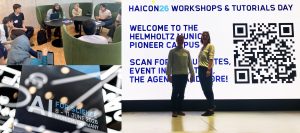
About one year after the launch of the second cohort of the STEP UP! Fellowship, fellows, supervisors – scientists from European Centre for Medium-Range Weather Forecasts (ECMWF), the German Weather Service (DWD) and the University of Cologne, The University of Bonn and Forschungszentrum Jülich – gathered in Bonn for a half-time event that combined scientific exchange, reflection, and a strong sense of community.
Orphaned orangutans kicking off the event, science communicator and documentary host Iris Zink (known to many through Terra X) shared impressions from her work in Borneo. The tropical rainforest, she explained, operates as a biotic pump – a self-reinforcing hydrological system in which the forest itself drives atmospheric moisture recycling. Water evaporates, forms clouds, and returns as rainfall, sustaining the ecosystem that produced it in the first place.
Her message resonated strongly with the audience of atmospheric scientists:
Protecting our species means protecting our environment—and protecting our climate.
The Origins of the Fellowship
The STEP UP! Fellowship is closely tied to the broader CESOC-ECMWF collaboration. This partnership dates back to October 2020, when CESOC was founded to support Bonn’s bid to host ECMWF’s new premises. The collaboration played an important role in the successful establishment of ECMWF in Bonn. Out of this partnership grew the STEP UP! fellowship programme. In collaboration with DWD, four fellowship positions were created to strengthen the connection between academic research and operational forecasting. Today, the programme links researchers from Universities in Bonn and Cologne, the Forschungszentrum Jülich, ECMWF, and DWD – creating a vibrant regional network around weather and climate science.
Fellows at the Halfway Mark
At the heart of the event were the fellows themselves. The second cohort – Francesca Covella, Eleni Kalogeraki, Sandra Klewinghaus, and Kim Weiss – presented the current status of their projects and shared reflections on their first year in the programme.
Their research topics illustrate the diversity of modern Earth system research:
-
Francesca Covella – Discerning the effect of the Land Data Assimilation System on flood forecasting
-
Eleni Kalogeraki – Investigating GNSS-R observation usage over land surfaces
-
Sandra Klewinghaus – Interfacing with Digital Twins of the Earth system
-
Kim Weiss – Exploiting synergies between the EarthCARE satellite mission and ground-based supersites
Together, these projects combine satellite observations, modelling systems, and high-performance computing to improve the understanding and prediction of weather and climate processes.
Navigating the PhD Journey
The gathering also brought together fellows from the first cohort. Luise Schulte and Paolo Andreozzi have recently completed their 3-years fellowships and are now approaching the final stage of their PhDs. Over the coming months they will continue their research before defending their theses later this year.
Their projects focus on key atmospheric processes:
-
Luise Schulte – Modelling water in Arctic clouds
-
Paolo Andreozzi – Meteorological effects of atmospheric composition
Drawing on her field experience during an Arctic research campaign in summer 2025, Luise offered a memorable metaphor for the PhD journey. She compared doctoral research to a research vessel navigating through sea ice. Progress requires patience and persistence. Sometimes the vessel moves steadily forward; sometimes it must break through thick ice or find an alternative route. The path is not always straightforward – but it leads to discovery.
Continuing the Network
The event also welcomed alumni of the fellowship programme. Florentine Weber, a fellow from the first cohort (2023–2025), contributed to integrating irrigation and urbanisation processes into the ECMWF Integrated Forecasting System (IFS). She now works at the Jülich Supercomputing Centre (JSC), continuing to strengthen the CESOC-ECMWF collaboration through science coordination and cross-project activities. She currently supports collaborative initiatives such as the WeatherGenerator and RAINA projects, linking Earth system scientists with experts in high-performance computing and algorithm development.
Another alumna, Katerina Anesiadou, continues her research as a scientist in data assimilation at the German Weather Service.
Looking Ahead
The programme concluded with perspectives on emerging research topics. Presentations touched on the recent EarthCARE satellite mission, constraints on cloud representation in the ICON model presented by Axel Seifert (DWD), and new research directions in subseasonal predictability.
One particularly intriguing avenue is the application of machine learning to improve understanding of predictability on subseasonal time scales – an area being explored together with researchers such as Julian Quinting at the University of Cologne. New STEP UP! fellowship calls are expected to open in late spring. Stay tuned!
Photo credits: Vanessa Jacobi, Florentine Weber