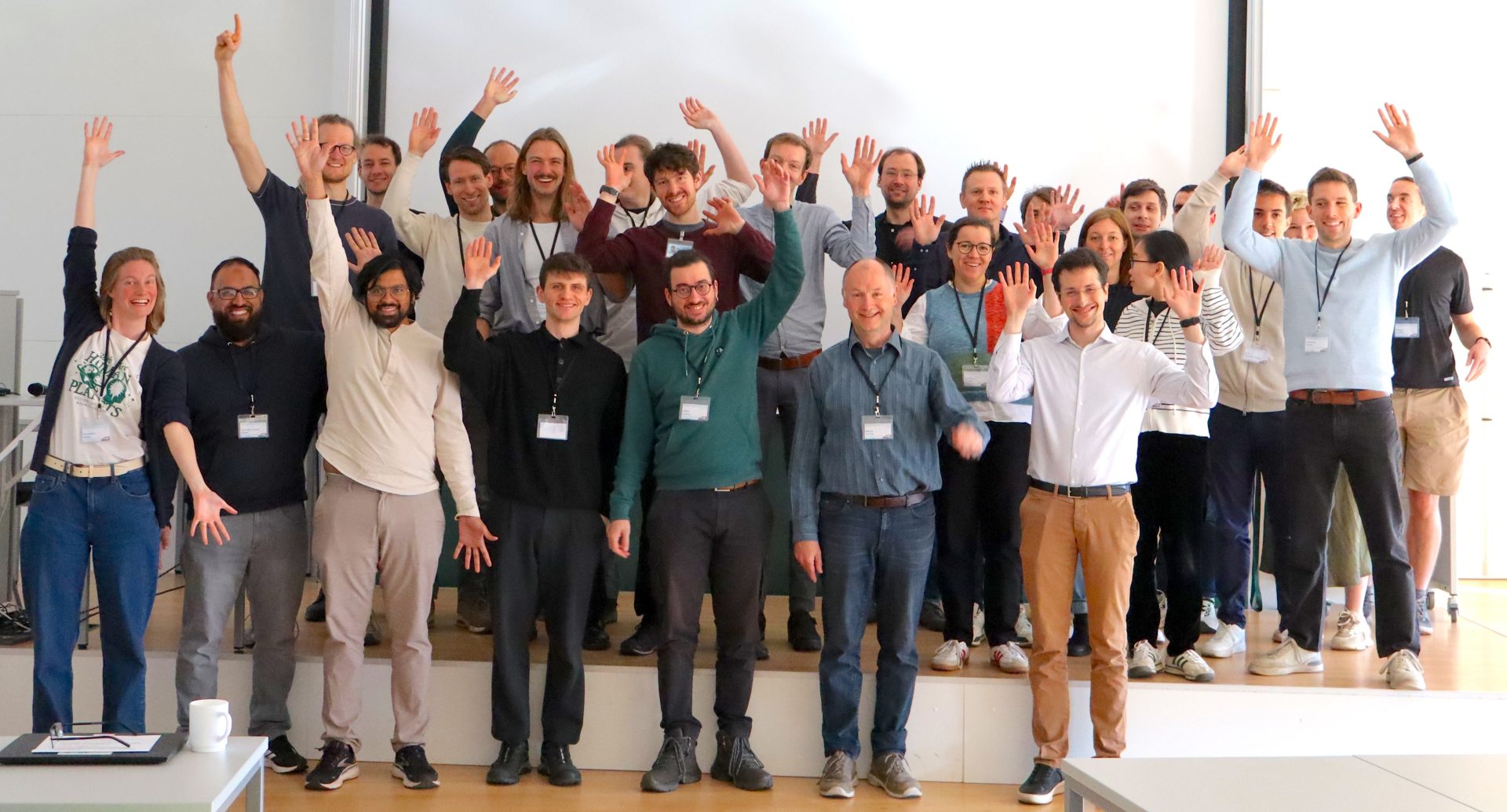
On March 4th and 5th, 2026, top researchers from Europe and beyond convened at the Meteorological Institute of the University of Cologne for the workshop on “Advancing AI Climate Models”. Organised by Martin Schultz and Florentine Weber within the AlgoEarth semester program, the event was hosted by the University profile line IMfESS – Intelligent Methods for Earth System Science in collaboration with the Centre for Earth System Observations and Computational Analysis (CESOC). The meeting aimed to reimagine how Artificial Intelligence can best constitute future climate models, going beyond simplistic weather foresight.
From Predicting Weather to Understanding Climate Dynamics
AI has already transformed weather predictions, delivering more accurate insights on short forecasting timescales. Yet, translating AI’s potency into climate modelling remains a pioneering undertaking. The complex interplay between atmospheric, oceanic, and terrestrial components, coupled with a paucity of long-term observational data, presents significant challenges.
“Weather is relatively straightforward to validate. Climate, however, poses a very different problem,” a key participant aptly captured. How can AI not only make predictions but also foster deeper understanding? This inquiry drove the essence of the discussions.
From Ocean Current Insights to Green Vehicle Solutions
The conference program featured a diverse array of presentations from two-hands full top AI-thinkers and climate researchers from entities like NVIDIA, ECMWF, CSIC, JSC/FZJ, DKRZ, KIT, Beyond Weather, and the renowned Chalmers University of Technology.
For instance, Peter Manshausen (NVIDIA) introduced new non-autoregressive methods in climate simulation. His caution: “I question the interpretability of NWP and MLWP models because you can tune them to achieve reasonable outputs – let’s learn from this!”
Jose Gonzales-Abad (CSIC) detailed DestinE, a novel climate emulator, revealing insights into the relationships between climate systems and Earth’s biophysical processes.
Meanwhile, Caroline Arnold and Paul Keil (Hereon) discussed advancements in the ICON framework and cloud microphysics, exploring AI’s potential to better simulate the planet’s water cycle.
Christian Lessig (ECMWF) posed the thought-provoking question: “Are machine learning-based climate models possible?” This question fuelled discussions on hybrid modeling architectures, blending both traditional numerical methods and AI techniques.
Sonia Yeh (Chalmers University) provided an inspiring illustration of behavior-aware climate-society coupling. She demonstrated, for example, how GPS data from electric vehicles can optimise charging infrastructure for both user convenience and climate resilience – bridging AI’s predictive power with human habit modifications.
The conference included poster presentations on cutting-edge topics like fog monitoring in the Atacama Desert, a startup named Beyond Weather, and a new methodology to collect large datasets called Xaurora.
Panel Debates: Pure AI or Hybrid Models?
Two high-engagement panels tackled essential questions. The first panel (“Pure versus hybrid models”) analysed error structures, generalisability, and need for evaluating fairness and comparability within AI-driven climate models. A consensus emerged: “Model and data development must deftly align,” a fundamental takeaway from Florentine Weber’s moderated sessions.
The second panel (“Local to global climate transitions”) explored the broader implications of climate change through storm trajectories and atmospheric transport studies. Participants debated the requisite vertical and horizontal model integrations necessary for linking minute soil moisture variations to the vast carbon cycle.
Technological Innovations and Energy Efficiency
The conference was not just a reflection on climate projections but also previewed potential technological developments. Charlotte Debus (KIT) eloquently emphasised: “There’s no low-energy science. Game the system – build AI models as energy-efficient as possible, understanding new hardware will follow.”
Such bold theoretical statements introduced the conference’s core ethos: unabashed ambition toward solving grand challenges coupled with mindfulness toward ecological and computational responsibility.
A Glimpse Ahead: Collaborative Endeavours
The workshop reinforced bonds and foreshadowed future collaborations. Following the event, for more joint research initiatives was encouraged – a testament to the spirit of this gathering.
Looking ahead, the community is optimistic about the evolution of AI’s role in climate science. The success of “Advancing AI Climate Modelling” underscores the need for interdisciplinary dialogue, technological creativity, and stewardship. It also drives the collective aspiration to better understand, model, and mitigate the global climate challenge.