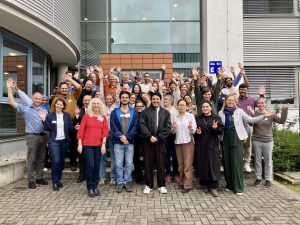
Does an AI climate model need to see every storm, every ocean eddy and every gust of wind to understand the climate? Or can it learn the big picture from coarse data and fill in the details later? That question brought about 50 researchers to the InnoDom in Cologne, with as many again online, for a full day of talks and debate among atmospheric scientists, numerical modellers and machine learning (ML) researchers. The workshop was conceived and organised by Martin Schultz, Agnes Lohs and Florentine Weber of the Earth System Data Exploration (ESDE) group at the Jülich Supercomputing Centre, who brought the community together. It was supported by the HClimRep project, the CESOC ML working group and the ELLIS Unit NRW.
Martin Schultz (Forschungszentrum Jülich, University of Cologne) opened by framing the problem. Small-scale weather shapes the large-scale climate, partly as an average effect, partly as random “noise”, and partly through energy that cascades upward from small to large scales. Coarse AI models run stably for decades, but this may be because they smooth away exactly these interactions. Generative models can fill plausible fine detail back into coarse fields, yet getting the warming signal right may still require km-scale simulations of future climates.


The speakers then approached the question from different sides. Nikki Vercauteren (University of Cologne) looked at the lowest kilometre of the atmosphere, where the land surface meets the weather above. Data for this layer are scarce, so she argued for AI that works hand in hand with physics: learning relationships through physically based scaling variables, keeping conservation laws untouched, and correcting existing process-based schemes rather than replacing them. Stefan Kollet (Forschungszentrum Jülich, CESOC and University of Bonn) went underground. Groundwater and soils have a long memory, with response times from days to thousands of years. Coarse grids can balance the water budget but lose that memory, which biases drought persistence. His suggestion is that AI could learn compact “memory” closures for the slow processes we cannot afford to resolve, tested against satellite and well observations.
Ankit Patnala (Forschungszentrum Jülich) presented lessons from building HClimRep, a foundation model for the atmosphere and ocean. Long AI forecasts tend to drift towards average conditions or become unstable at high resolution, and downscaled fields often come out blurry. He offered a set of “recipes”, for example forecasting first and downscaling afterwards, or training both together, to be tested in practice. Lizzie Kendon (UK Met Office) stressed that AI should leverage rather than replace physical modelling. Emulators need training data spanning cold past and high-end warming conditions, and transferring them across regions appears harder than across time, so some km-scale data is needed everywhere. Her conclusion was that AI makes high-resolution simulations more valuable, not less.


Greg Hakim (University of Washington) used differentiable weather models to search for extremes. His results suggest that “gray swan” events, storms more intense than any yet observed, lurk close to ordinary ones. This is not a probability estimate, but it offers a useful “what if” tool and a source of new training data. Nils Wedi (ECMWF) closed the series with a sober perspective: whether resolution matters depends on the goal. Some large-scale phenomena only exist if the small scales driving them are resolved, yet for many decisions AI emulation and downscaling may suffice, and there is limited evidence that higher resolution changes projected trajectories.
A round of lightning talks showed how far the resolution question reaches. Contributions covered the Destination Earth climate emulator and machine-learning downscaling of regional climate models within the Copernicus Climate Change Service (C3S). Others looked at how the stratosphere influences winter storms and at AI methods for modelling the dispersion of stratospheric particles, as well as at hyper-resolution groundwater modelling on a global scale. Further topics were air pollution and climate change, and extreme precipitation in AI weather models. One talk made a point that is easy to forget: resolution is not free, and even the input data must keep up. It showed how satellites and machine learning can produce emission inputs at 5 km for Earth system and AI models.

The lively discussions that followed centred on three questions: which small-scale effects an AI climate model must represent and which can stay implicit; whether the stability of coarse AI models reflects a learned closure or merely a smoothing bias; and which training data would make downscaling trustworthy in a future, warmer climate. There were no final answers, but a shared direction emerged: high-resolution physical models and AI are partners, and the best blend of the two still has to be designed together.

Several open points remain for the road ahead. What actually makes data trustworthy? How much resolution do we need where, and can ML models capture tipping points? And how can the community contribute tests to the wider AI community, for example via AIMAP? These questions will keep us busy until the next workshop.