The 4th CESOC Members’ Assembly was the first one held on the Forschungszentrum Jülich, and the last one for two of our directors.
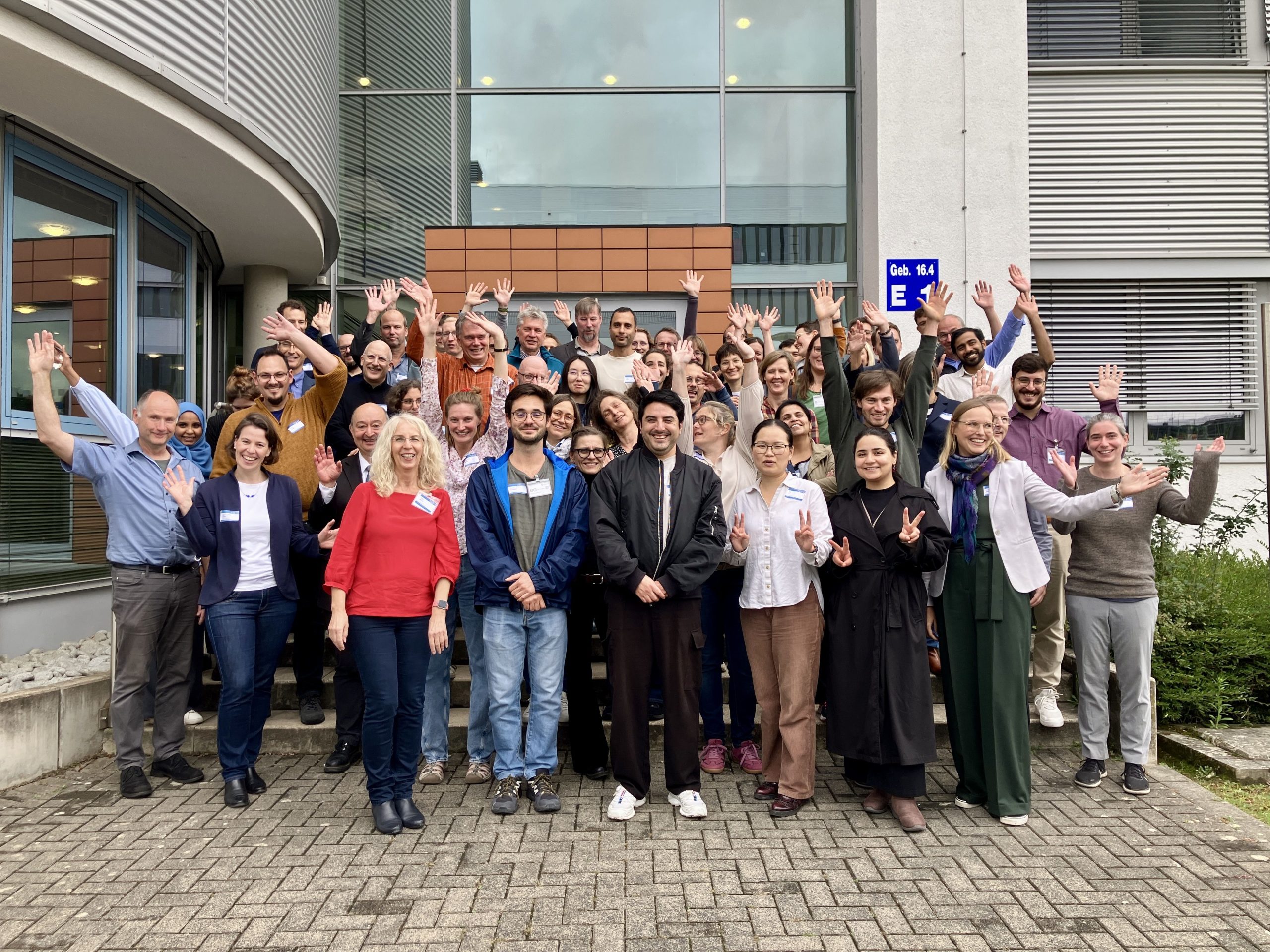
When a centre for Earth system observation and computational analysis wants to talk about the future, it helps to meet next door to Europe’s fastest computer. On Thursday, 8 October 2026, more than 60 people came to the Forschungszentrum Jülich campus for the 4th CESOC Members’ Assembly, the first one hosted here. Members from the Universities of Bonn and Cologne were joined by guests from the ministry, colleagues from ECMWF, and interested scientists from partner institutions.

For anyone new to us: CESOC is the Centre for Earth System Observation and Computational Analysis. Within it, the University of Cologne (UoC) works together with the University of Bonn (UB), Forschungszentrum Jülich (FZJ), and operational weather services at the German and European levels.
“It used to take me around an hour to run a lap around the campus,” says outgoing CESOC Director Martin Schultz, describing the size of the Jülich campus.
The day also marked a turning point. It was the last Members’ Assembly for directors Martin Schultz and Petra Mutzel, who will step down after four years in office. Thank you, Martin and Petra, for four years of generous input, sharp ideas, and a steady hand in building a network where observations, models and algorithms learn from each other. You have shaped CESOC from its start, and we will keep running our experiments in the spirit you set, with good data, open minds and a healthy respect for uncertainty.


The question of who follows onboard is on the ballot. Six candidates introduced themselves in two minutes each: Stefan Kollet (FZJ), Anke Nölscher (FZJ), Jürgen Kusche (UB), Anne Driemel (UB), Susanne Crewell (UoC) and Christian Sohler (UoC). For the staff and students’ representation, Anne Caroline Lange (FZJ) and Philipp Breul (UoC) (as co-representative) stood for election. The catch: the quorum was not reached, so the result will have to wait until November. The candidates remain in the starting blocks.
“I’ve been a professor for 20 years,” says CESOC Director Susanne Crewell from the University of Cologne, explaining that CESOC is an important platform for sharing her expertise and putting it to use.
The afternoon symposium was open to everyone, and two keynotes set the tone. Anke Nölscher (Director of the Troposphere Division, ICE-3) showed the art of uncovering statistical patterns in observational atmospheric data, in space and in time. Aleksandar Bojchevski (Trustworthy AI Lab, University of Cologne / ellis:nrw) took on the question of how to tame unpredictable AI, a topic that returned in the afternoon’s discussion.


Earlier in the day, short talks by Aiko Voigt (dynamics of the atmosphere), Philipp Breul and Michael Schindelegger (IDEA – S4S) and Christian Sohler and Susanne Crewell (AlgoEarth, SFB) had already shown how wide CESOC’s range is.
The poster lightning session did the same. Topics included data infrastructure in the DETECT project, cloud representation in ICON versus airborne measurements from COMPEX, and the global tropopause in reanalyses versus GNSS radio occultation (2001–2025). Others dealt with the oxidation of methylamines in the atmosphere, satellite-based solar-induced fluorescence for early plant stress detection, and kilometre-scale global simulations, including gravity waves with ICON on JUPITER. One title posed a question many modellers will recognise: Less Data, Same Science?, about compressing ERA5 for atmospheric transport modelling.
Speaking of kilometre-scale simulations on JUPITER: guests and members could see the machine for themselves. JUPITER is Europe’s first exascale supercomputer, capable of more than a quintillion (10¹⁸) calculations per second. Tours ran in parallel to the sessions, for the SAB and external guests at midday and for CESOC members in the afternoon. For a community that plans to run its models on this machine, seeing it up close was a highlight.
“I come from space. I’ve spent my entire career working with space technologies,” says Jürgen Kusche, CESOC Director from The University of Bonn, who aims to build stronger connections between space agencies and CESOC.
In the discussion on future directions, AI took centre stage, but not uncritically. How can it support deep research and education?
There was also healthy scepticism. AI is a natural helper for visualisation and graphs, but its role in research itself needs exploring. Our members asked what the scientific value is of AI-supported results that rest on long-term observations which AI cannot produce. And as no model will take measurements for us, the group asked how to make better use of existing observations, what new ones are needed, and how to build a more integrated observing system. Building on the observation impact workshop, a new working group may emerge.
Further ideas included devising tough scientific questions to test whether AI can produce meaningful research, and finding ways to judge the quality and reliability of its results. Aiko Voigt’s question “What is Earth climate sensitivity?” and good practices for AI-assisted coding for the next generation also made the list.
Advice from the SAB
While the symposium came to a close, the Scientific Advisory Board met with current and new directors. The talks covered reanalysis contributions to new products, collaborations with space agencies such as EUMETSAT, and quantum computing.
Outlook
A farewell, an unfinished election, a supercomputer and plenty of debate about AI: not bad for one day. Thanks to everyone who came, presented, and asked the hard questions!