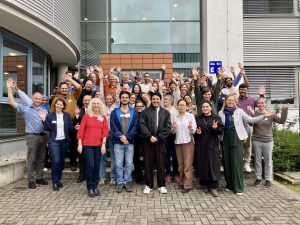
A new Theme Issue in Philosophical Transactions A brings together the main outcomes of the Tropospheric Ozone Assessment Report Phase II (TOAR-II). Behind it stands a data infrastructure developed at Forschungszentrum Jülich, our CESOC partner.

What is TOAR?
Ozone plays two very different roles in the atmosphere. In the stratosphere, it forms the protective ozone layer. Near the Earth’s surface, in the troposphere, it is an air pollutant and a greenhouse gas. There it can harm human health and vegetation, and it influences the climate system.
The Tropospheric Ozone Assessment Report (TOAR) is an international scientific initiative started by the International Global Atmospheric Chemistry (IGAC) project. It aims to provide an up-to-date assessment of the global distribution and trends of tropospheric ozone, from the surface to the tropopause, and to make the underlying data accessible to the research community. More than 200 experts from over 35 countries have contributed. TOAR is supported by IGAC, Forschungszentrum Jülich (FZJ), the US National Oceanic and Atmospheric Administration (NOAA) and the World Meteorological Organization (WMO).
The first phase, TOAR-I (2014–2019), delivered the first comprehensive global assessment of tropospheric ozone. TOAR-II built on it and extended its geographical and scientific scope. The project produced a Community Special Issue with 58 peer-reviewed publications.
The new Theme Issue
The new Theme Issue in Philosophical Transactions A brings the main scientific results of TOAR-II together in eight publications. It shows how ozone is distributed around the world, how it has changed over time, and how it affects people, ecosystems and the climate.
The central TOAR-II overview paper (H. M. Worden et al.) assesses the global distribution, burden and trends of tropospheric ozone. Seven further papers look at specific aspects:
- Health: Kerr et al. characterise the health impacts of long-term surface ozone exposure.
- Vegetation: Emberson et al. examine the risk of surface ozone to crops such as wheat, rice and soybean, and to three forest species.
- Oceans and polar regions: Sommariva et al. report the most comprehensive dataset yet on lower-atmosphere ozone over open oceans and polar regions.
- South America: Seguel et al. present the first regional assessment of tropospheric ozone over South America for the early 21st century.
- Satellite observations: Hubert et al. use longer and improved satellite records, additional datasets and new harmonisation approaches for a second, more confident assessment of present-day ozone and long-term change.
- Climate interactions: Szopa et al. review ozone as a short-lived climate forcer and the influence of climate change on tropospheric ozone.
- Stratosphere–troposphere exchange: Keeble et al. synthesise recent advances in understanding the magnitude, mechanisms, variability and future evolution of ozone transport across the tropopause.
Taken together, the papers cover tropospheric ozone from its distribution and transport to its effects on health, ecosystems and climate.
The data infrastructure behind the assessment
A central part of TOAR-II was its data infrastructure, which was developed and is operated at the Jülich Supercomputing Centre (JSC) by the Earth System Data Exploration (ESDE) research group.
- The TOAR Data Centre at JSC provides access to harmonised and verified global surface ozone observations and related data. It offers an interactive dashboard, a chatbot, data services and APIs, and software for integrating TOAR data into research workflows.
- The TOAR Data Portal is the central access point to ozone-related datasets and their descriptions. It covers surface, satellite, aircraft, ozone sonde and LiDAR observations as well as model data.
ESDE group leader Martin Schultz also served for more than ten years as co-chair of TOAR-I and TOAR-II.
Why this matters for CESOC
CESOC aims to observe, understand and predict the Earth system, linking new observations with modelling and bringing geosciences together with HPC, big data and AI/ML methods. TOAR is a concrete example of that approach, and it comes from within our own network:
- Observations meet infrastructure. TOAR-II relied on harmonised, quality-controlled observations from many sources. The Jülich data infrastructure made this possible at global scale, which is the kind of observation–computation link CESOC stands for.
- Open data for the community. The TOAR Data Portal and Data Centre give CESOC researchers direct access to a large collection of ozone observations from the surface to satellites, and to model data. This is useful for research on atmospheric composition, air quality, climate interactions and model evaluation, and for data-driven and ML-based methods that need well-curated training and validation data.
- Relevance across disciplines. The Theme Issue touches topics that run through CESOC’s partner institutions: remote sensing, atmospheric chemistry, vegetation and health impacts, climate forcing and stratosphere–troposphere exchange.
- A showcase for what the Rhineland partnership can do. Harmonised data, HPC-based services and international scientific coordination together made a global assessment possible.
What comes next
TOAR continues with TOAR-III. Forschungszentrum Jülich will keep maintaining and developing the TOAR data infrastructure. Anke Nölscher (Institute of Climate and Energy Systems – Troposphere, ICE-3) joins the steering committee. Martin Schultz (ESDE–JSC) and Helen Worden (NCAR) have stepped down as co-chairs and handed over to Rodrigo Seguel (Pontificia Universidad Católica, Chile) and Sophie Szopa (LSCE-IPSL, France).
Get involved
Contact: Prof. Dr. Martin Schultz (ESDE, JSC) and Sabine Schröder (JSC)
Read the full Theme Issue: https://royalsocietypublishing.org/rsta/issue/384/2332
TOAR Data Portal: https://toar-data.org/
TOAR Data Centre: https://toar-data.fz-juelich.de/
TOAR news article: https://toar-data.org/toar-ii-theme-issue/
ESDE news article: https://www.fz-juelich.de/en/jsc/about-us/structure/research-groups/esde/toar-ii-theme-issue