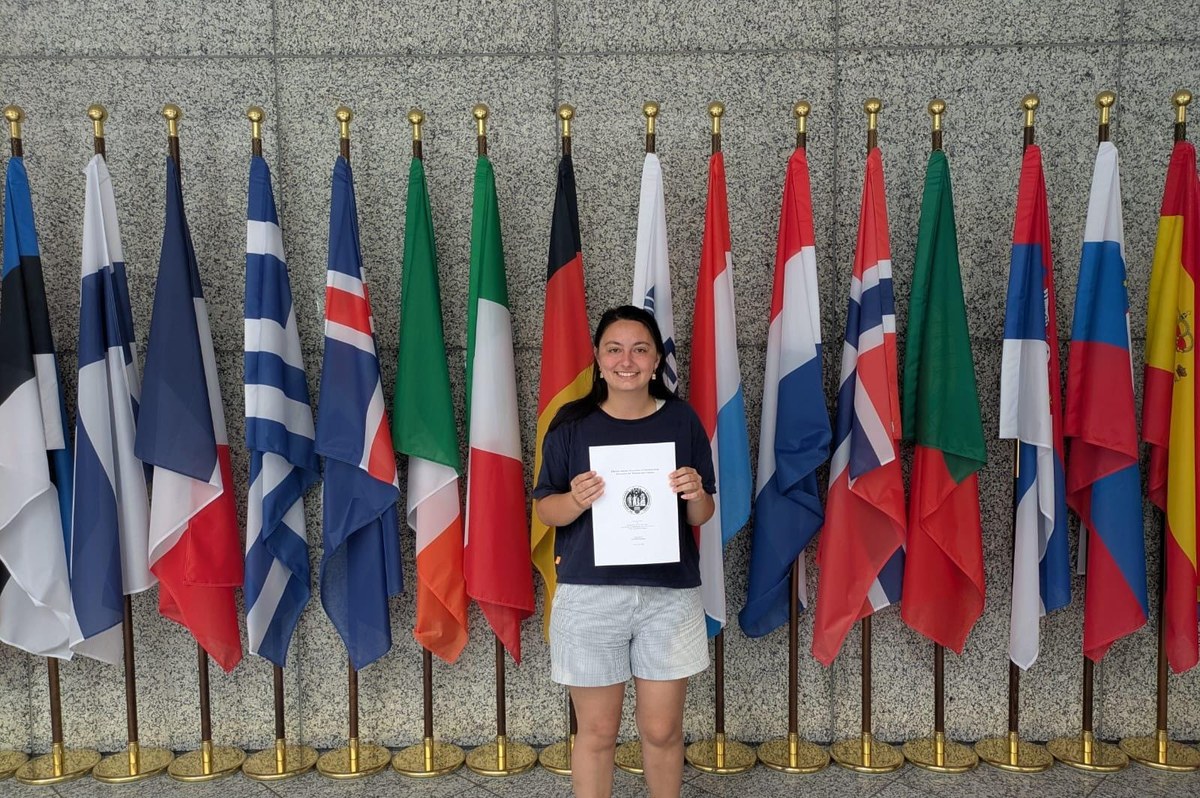
On 4 August 2026, Mathilde Leuridan successfully defended her PhD at the University of Cologne. Her dissertation, Efficient Feature Extraction of Petabyte-Scale Datacubes for Weather and Climate, was carried out in collaboration with the European Centre for Medium-Range Weather Forecasts (ECMWF) and focuses on a growing challenge for weather, climate, and Earth system science: how to efficiently access the data we actually need from increasingly large datasets.
As simulations become higher-resolution and observations become more frequent, scientific datasets are reaching petabyte scale. For researchers working with these data, the challenge is no longer simply storing large datasets, but finding and extracting the relevant information without moving and processing vast amounts of unnecessary data.
Mathilde’s research addresses this challenge by enabling more targeted data access. Instead of retrieving a large rectangular section of a dataset and filtering it afterwards, her approach identifies the data required for a specific query before it is transferred. This can substantially reduce data movement and processing costs.
A central result of the work is Polytope, an algorithm that allows researchers to describe data requests using more flexible shapes and regions than conventional rectangular datacube selections. In experiments, this approach reduced the amount of extracted data by up to 99%, while keeping the overhead for identifying the required data small.
For observation data analysis and computational science, this opens interesting possibilities: from extracting specific spatial or temporal features from large Earth observation datasets to supporting more scalable analysis and AI workflows. The underlying approach is also not limited to weather and climate data and can be relevant to other scientific domains working with large, multidimensional datasets.
The research was conducted with the Jülich Supercomputing Centre (CESOC Director Martin Schultz) and is particularly relevant for large-scale initiatives such as Destination Earth and WarmWorld, where efficient access to massive Earth system datasets will be essential.
Mathilde’s PhD provides a foundation for further work on scalable data access and analysis, helping researchers spend less time moving data and more time working with the information they actually need.
Read the full article to learn more about Mathilde’s research, Polytope, and the challenges of accessing the next generation of weather and climate data.