
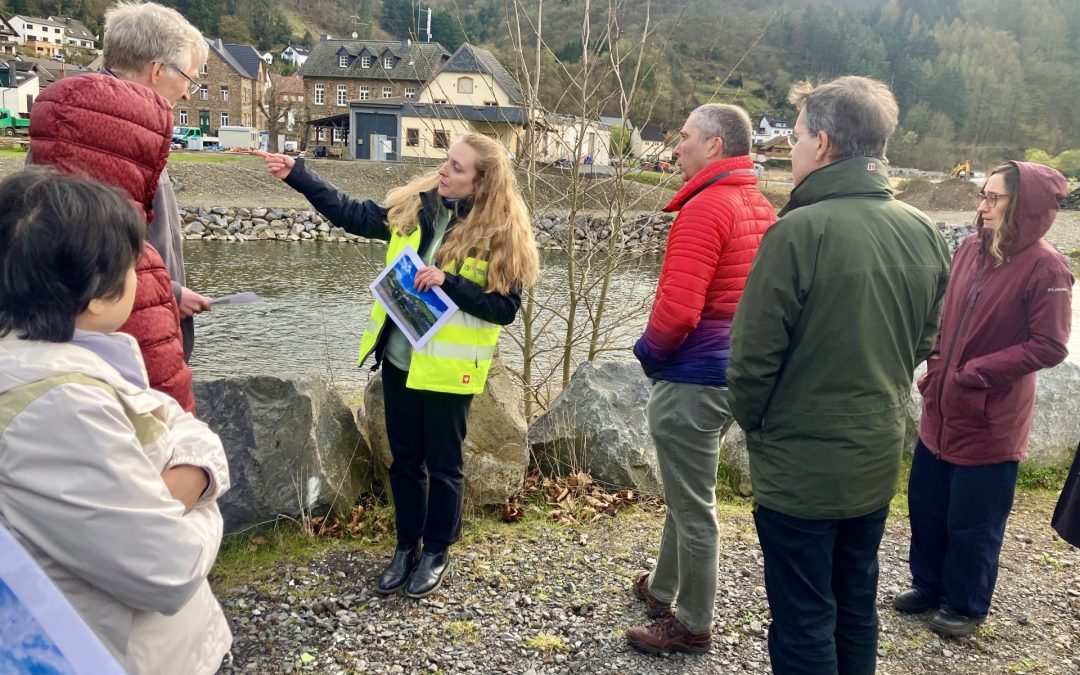
These days, the 38th GEWEX Scientific Steering Group (SSG-38) meeting, hosted by the European Centre for Medium-Range Weather Forecasts (ECMWF) and Copernicus, the Earth observation component of the European Union’s Space programme, is taking place in Bonn. GEWEX — the Global Energy and Water Exchanges project — is part of the World Climate Research Programme. Its mission is “to observe, understand, and model the hydrological cycle and energy fluxes in the Earth’s atmosphere at and below its surface.” Thereby, GEWEX represents a central pillar of Earth system science, closely linked in CESOC. Its work connects fundamental questions of weather and climate with the development of algorithms and models that help us better understand and predict complex processes within the Earth system.
Two GEWEX members, Susanne Crewell (SSG) and Florentine Weber (GHP – Hydrology), took the international participants on an excursion to the Ahr Valley. The visit was joined by additional members from CESOC and the Geoverbund ABC/J, who co-organised the tour.
The excursion was guided by Lisa Burghardt, a PhD student of Holger Schüttrumpf at RWTH Aachen University. The Ahr Valley is a picturesque region in western Germany, well known for its red wine and popular hiking routes. Despite its idyllic landscape, the valley experienced a devastating flood in the summer of 2021.
Historical records show major floods in 1804, 1910, and most recently in 2021. One key factor lies in the region’s geology: the rocky subsurface limits infiltration, meaning that rainfall cannot be effectively absorbed. Instead, water rapidly flows down the steep vineyard slopes directly into the valley, amplifying water levels in addition to the intense precipitation itself.

Water levels rose dramatically as debris accumulated and created blockages. Bridges became clogged not only with vegetation and trees, but also with vehicles and fragments of buildings. Measuring water levels during the event proved extremely challenging, as monitoring stations and their infrastructure were partially destroyed or rendered inoperable.
Although warnings had been issued, they were not early enough to prevent the scale of the disaster. Since then, efforts have focused on improving both the accuracy and timeliness of early warning systems, as well as strengthening coordination in emergency response. The warning process itself also raises governance questions: should national institutions such as the German Weather Service take the lead, or do responsibilities remain primarily at the federal state level?
Lisa Burghardt provided valuable insights throughout the tour, particularly drawing on her expertise in hydraulic engineering and bridge design.
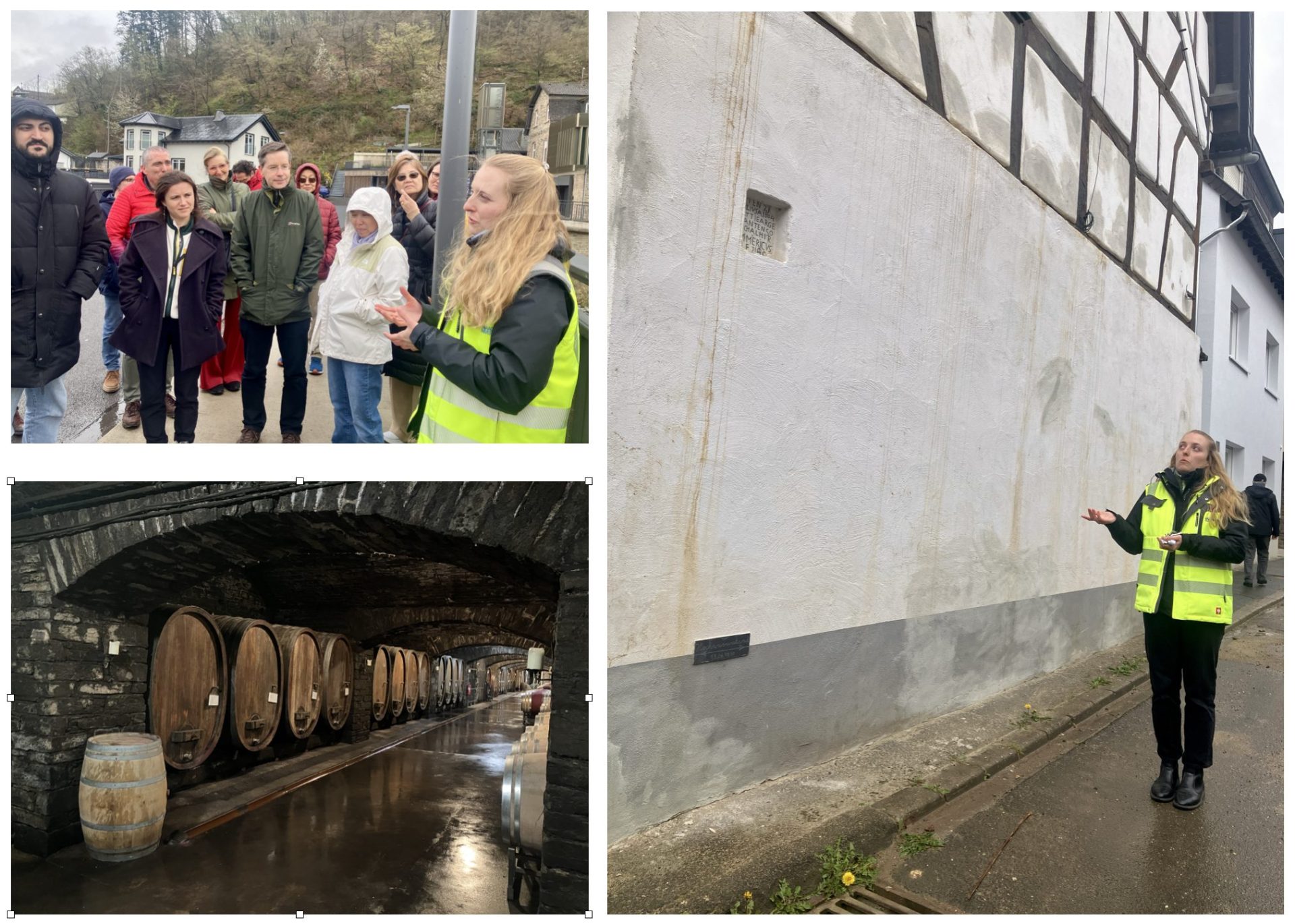
The visit concluded at the Weingut Mayschoss-Altenahr winery. While their cellars had been completely flooded and later pumped out, the wine barrels – crafted from oak sourced from regions such as France, the western United States, and locally from the Ahr Valley – largely remained intact. Typically stored at a constant temperature of 12–15°C, these barrels preserved their contents despite the extreme conditions. Today, the winery is in the process of constructing a new main building, symbolizing both recovery and resilience in the region.
For GEWEX, CESOC, and the Geoverbund ABC/J, the Ahr Valley represents a scientifically compelling region where flood risk, landscape characteristics, and human systems intersect. Addressing such challenges requires truly interdisciplinary approaches, combining atmospheric science, hydrology, engineering, and data-driven modeling to better protect communities and reduce future impacts. Equally important is the international exchange of expertise, where global knowledge meets local experience to develop more robust, timely, and effective solutions.