Rain falls on everyone. A heatwave doesn’t check your passport, your pay grade, or your pronouns before it arrives. So surely the weather is gender-neutral?
Not quite. The weather may be, but what it does to us is not.
That was the question hanging over a virtual workshop on 29 October, “Changing the Forecast: Diversity, Networking & Allyship in Research”, organised by the WeatherGenerator project and brought to life by Ruth Partzsch & colleagues from Forschungszentrum Juelich (FZJ). It’s a fair question to ask a room full of people who build machine learning models, run supercomputers and study the climate, because they are all trained to look for patterns. Sometimes the most important pattern is the one we’ve trained ourselves not to see.
The brain that predicts the weather also predicts you
Martin Schultz, CESOC Director at FZJ, opened the day, and he didn’t start with weather models. He started with brains. WeatherGenerator brings together 16 European partners, and he pointed to that diversity as one of the team’s real strengths. Then he turned to two books that shaped his thinking.
From A Brief History of Intelligence he took a humbling reminder: the chemistry steering our moods and decisions, such as dopamine and serotonin, is ancient. It was running long before anyone had a job title, a conference badge or an opinion about Python versus Fortran.
From Thinking, Fast and Slow he took an idea with uncomfortable consequences. Every mammal carries an internal model of the world, and every new piece of information is checked against it. We mostly pay attention only when something doesn’t match. That model is partly genetic and partly shaped by where and how we grew up.
Sound familiar? It should. It’s a forecast model, built from limited training data, that quietly fills in gaps and gets overconfident. We are all running one, and the bias it produces is rarely visible from the inside.
Whose climate is in the climate risk?
If our internal models are shaped by our own experience, then a research community where everyone has similar experiences will share the same blind spots. This is where Marina Andrijevic’s talk landed. Marina is a Research scholar at the International Institute for Applied Systems Analysis (IIASA).
Most of us know the first half of the scenario story. The RCPs, the Representative Concentration Pathways, describe how much greenhouse gas ends up in the atmosphere and how much extra energy that traps: RCP2.6, RCP4.5, RCP8.5. They are the “what if the physics goes this way” side of climate projections.
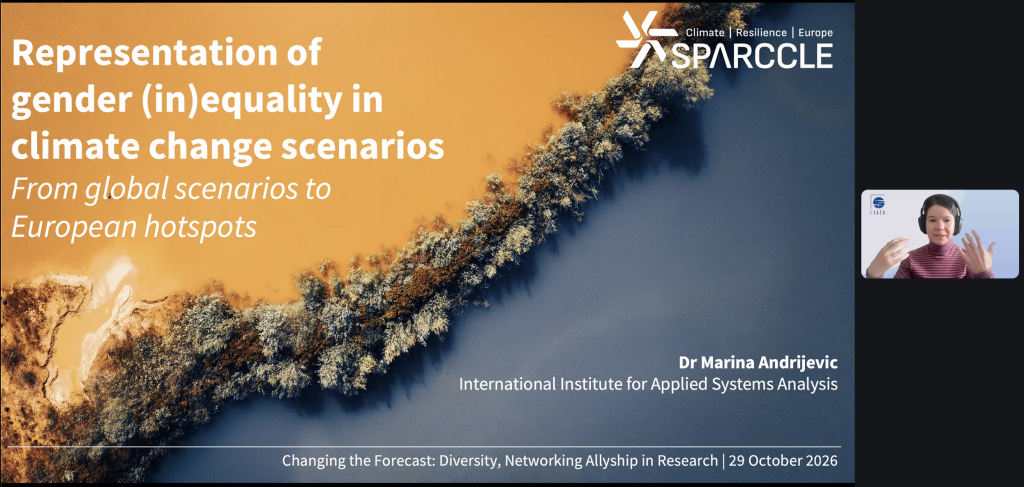
But the atmosphere is only half the story. The other half is us. The Shared Socioeconomic Pathways (SSPs) describe how society might develop: population, economic growth, education, inequality, technology, and how willing countries are to cooperate. From a world of sustainable development (SSP1) to one of regional rivalry (SSP3) or deep inequality (SSP4), each pathway is a storyline backed by numbers. Like the RCPs, they are not predictions but structured what-ifs. And the two are designed to work together: in the current generation of climate model experiments, you pick a societal path and a forcing level and get combinations like SSP1-2.6 or SSP5-8.5. The RCP tells you how hot it gets, the SSP tells you who is standing in it, and how well prepared they are.
That second question is exactly where gender comes in. Gender-specific vulnerability matters in climate risk assessments because people don’t experience climate risk identically. Caregiving, income, health and access to resources all shape who is exposed, who can adapt and who is left behind. Treat “the population” as one homogeneous block and the assessment looks tidy, but it has quietly erased people.
Then came the sobering twist: on some of these socioeconomic pathways, reaching gender equality could take a very long time. The scenarios we use to plan for a warmer world also might double as a forecast for equality, and not always a cheerful one.
The room is part of the system
A model is only as good as the people who build it, and people do their best work when they can speak freely. Bontu Lucie Guschke, Diversity and Anti-Discrimination Consultant, Speaker and Facilitator, took on exactly this: how diversity and discrimination are linked, and what it takes to make a research organisation inclusive in practice and not just on paper. Sexism, racism and other forms of discrimination don’t just hurt individuals. They narrow the range of ideas that get voiced. A safe working environment is a precondition for good science.


Bontu left the audience with a question small enough to act on and big enough to keep thinking about:
What is one thing I could do against discrimination today?
It’s not “How do I fix the whole system?” It’s one thing, today.
From individual action to shared infrastructure
Ruth Partzsch showed what “one thing” can grow into. She is a committed advocate of the Women in HPC network, and she made the case that networks like it, and Women in AI, are infrastructure. They offer mentoring, visibility, role models, collaborators and the quiet confidence of knowing you’re not the only one in the room who sees what you see. Organisations benefit too, with stronger communities, broader perspectives and a more inclusive culture.

The practical point was that nobody needs to reinvent the wheel. Projects like WeatherGenerator can support and strengthen the communities that already exist, rather than founding yet another structure. That’s allyship in practice: using the platform and resources you have to amplify what’s already working.
So, is the weather gender-neutral?
The atmosphere doesn’t care who you are. The science of understanding it does, because science is done by people with internal models, shaped by their experiences, who are prone to bias like everyone else. The best correction we have is other people’s models: different experiences, different questions, different blind spots.
Better forecasts need better data, and a better research community starts the same way. So change the forecast: find your network, notice your assumptions, support someone else’s voice, and pick your one thing for today.