The work by Ramiyou Karim Mache, Sabine Schröder, Michael Langguth, Ankit Patnala, and Martin Schultz at Jülich Supercomputing Centre (JSC) directly supports the Tropospheric Ozone Assessment Report (TOAR-II) project by applying machine learning to objectively classify air quality monitoring stations worldwide.
By transforming raw Earth observation data into standardised and actionable metadata, the approach helps improve global air quality analyses and the evaluation of climate models.
One particularly surprising result? – Main author Karim was genuinely surprised that the machine learning models achieved more accurate classifications than the original data providers for some stations (see Table below).
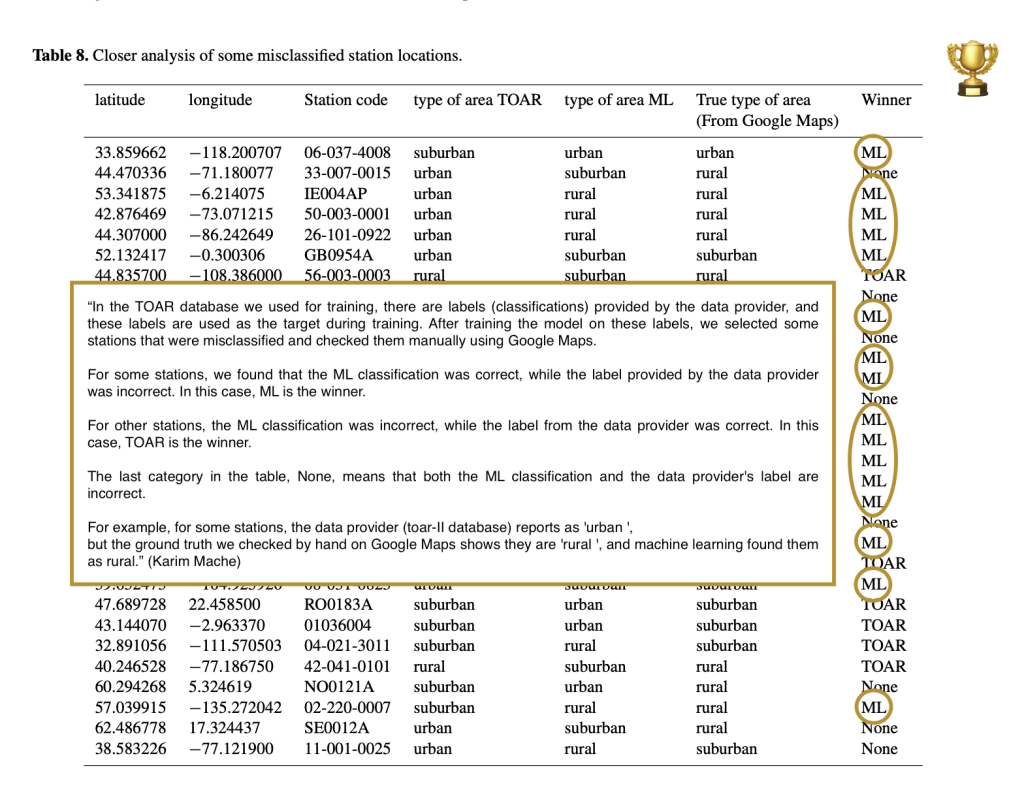
“That result was quite counterintuitive and demonstrated that data-driven approaches can sometimes identify patterns more consistently than manual classifications.”
What’s next? – The researchers plan to focus on data drift analysis and continuous model training. As cities expand and land use changes, station characteristics can evolve over time. A station classified as suburban today, for example, may become urban within a few years.
“To address this, we should develop an automated machine learning pipeline that continuously monitors for data drift, detects these changes, and automatically triggers model retraining whenever significant shifts are identified,” says Karim.
Why does this matter? – This research contributes to TOAR’s goal of quantifying the impacts of ozone on human health, vegetation, and climate, supporting environmental regulations and public health policies. By providing an objective and globally consistent classification of air quality monitoring stations, the machine learning approach reduces subjective biases and regional inconsistencies.
Ultimately, better and more consistent data means stronger global air quality analyses and more reliable climate model evaluations.
Congratulations to all authors on this important contribution!
Read the paper: https://gmd.copernicus.org/articles/19/5765/2026/ (or its summary).