

Directly following the third international Machine Learning for Earth System Modelling (MLESM) Workshop, which gathered about 250 experts from around the globe, a more focused group of around 25 participants came together for a hands-on hackathon. Guided by a team of ten tutors from European Centre for Medium-Range Weather Forecasts (ECMWF), Forschungszentrum Jülich (FZJ), and the Helmholtz-Zentrum Hereon, participants rolled up their sleeves and dove into coding challenges that bridged atmospheric science, machine learning, and high-performance computing.
Most of the hackathon participants were early career researchers, many with strong computational backgrounds and a growing passion for meteorology. Over the course of three days, they collaborated intensively on a series of challenges:
-
Challenge 1: Model evaluation, post-processing, and extreme events
-
Challenge 2: AI-based weather forecasting workflows and Anemoi
-
Challenge 3: Observations and satellite data integration
-
Challenge 4: Model stability and long-term climate simulations
-
Challenge 5: Diffusion Transformers for Earth system applications
Alongside the coding, participants benefited from lectures by experts that deepened their scientific and technical perspectives. Topics included:
-
History, misconceptions, and challenges in ML for Earth system modelling
-
Working with Earth system science data
-
Introduction to graph neural networks and AIFS
-
Evaluating weather and climate models
-
Coding an attention mechanism for weather AI models
-
Fine-tuning and use of pre-trained models, including foundation models for AIFS
-
Current topics in weather and climate research
This mix of practical challenges and conceptual insights made the hackathon a unique training ground for the next generation of researchers at the intersection of machine learning and Earth system science.
“Through the close supervision of the tutors on this project I learned a lot about the theory behind the models, beyond implementing them in code. – It was a useful experience to learn how to prioritise the delivery of a finished product in the given time frame.” – Participant Moritz Hauschulz (University of Oxford)
Interdisciplinary collaboration is key to addressing pressing global challenges: from climate change and the rise of extreme weather events to the rapid evolution of computational methods that can transform forecasting and climate prediction. The hackathon not only provided participants with new skills and perspectives but also strengthened a growing international community that is working towards more reliable, accurate, and innovative approaches to weather and climate modelling.
“It’s always a great pleasure to work with highly motivated students!” – Lecturer & tutor Zied Ben Bouallègue (ECMWF)
The future of forecasting will be shaped by exactly these kinds of collaborations – where curiosity, coding, and climate science meet.
Building on this momentum, plans to repeat the Hackathon are being considered for next year.
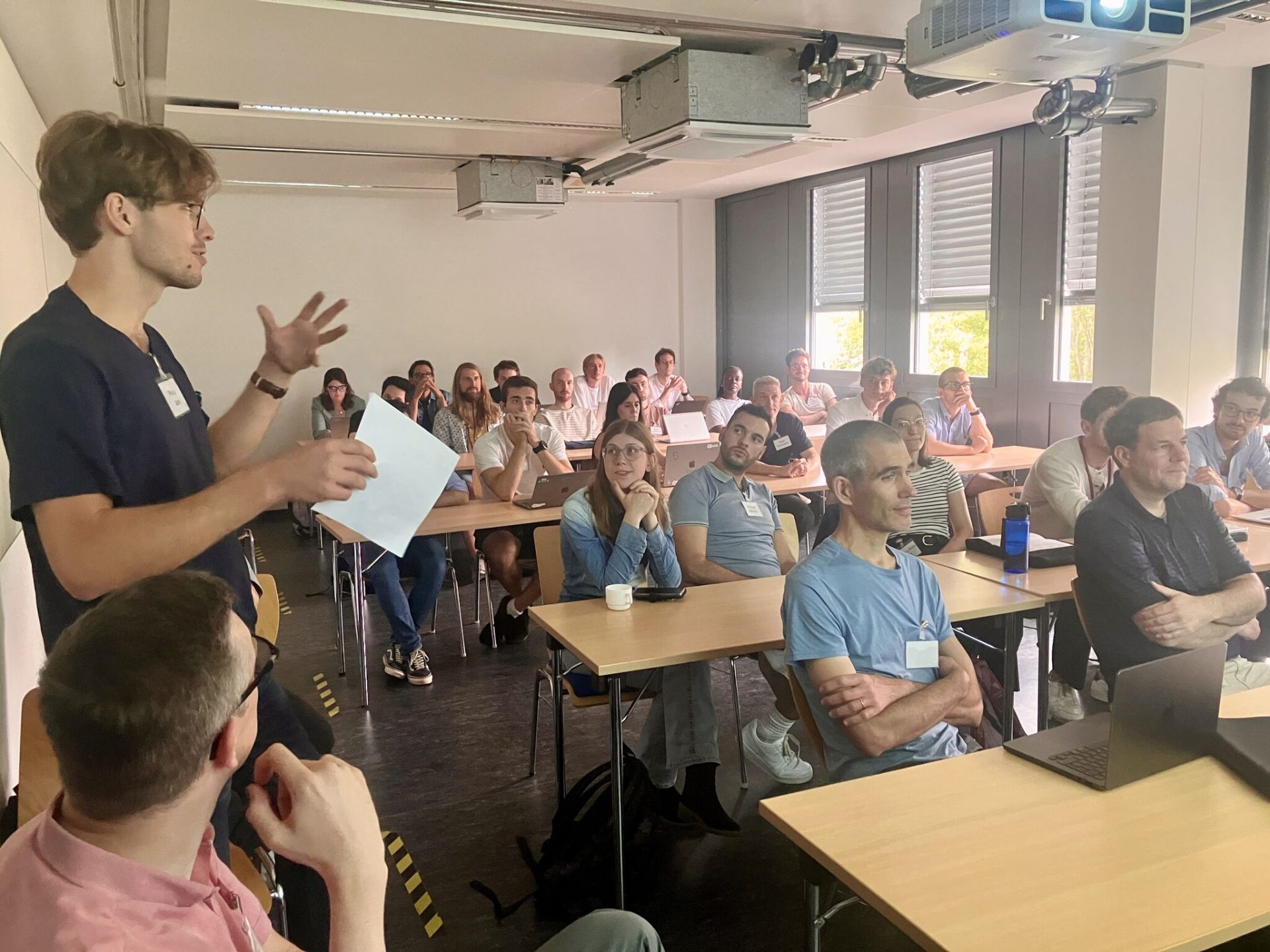
Pictures © TRA Modelling / CESOC

Pictures ©TRA Modelling / CESOC

Pictures © TRA Modelling / CESOC

Pictures ©TRA Modelling / CESOC

Pictures © TRA Modelling / CESOC

Pictures ©TRA Modelling / CESOC

Pictures © TRA Modelling / CESOC
