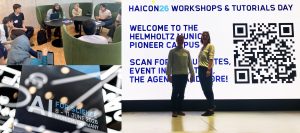
For the third time, CESOC brought its members together to reflect on the past year and look toward the Centre’s future. This year’s assembly was hosted by the Meteorological Institute at the University of Bonn and took full advantage of the sunny weather and their charming garden to foster relaxed, open exchange.
Around 50 members from the University of Bonn, University of Cologne, Forschungszentrum Jülich, European Centre for Medium-Range Weather Forecasts – ECMWF, and other partnering institutions, like, EUMETSAT, TU Delft, KU Leuven, gathered for a day of lively discussion, networking, and collaborative planning. Beyond reconnecting, participants came to share research, discuss joint projects, explore funding opportunities, and choose a new deputy for staff and student representation: Dr Anne Caroline Lange (Forschungszentrum Jülich) will now be joined by Dr Lukas Pfitzenmaier (University of Cologne) in representing the CESOC community.
Keynotes: Connecting Contrasting Topics across Earth and Computing
The keynote talks highlighted CESOC’s mission to unify diverse expertise at the intersection of Earth sciences and computational methods. The topics could hardly have been more different, yet all inspired conversations about shared challenges and opportunities. Audience feedback and the engaged questions made it clear just how valuable this variety was.
-
Prof. Uli Löhnert (University of Cologne): High-Resolution Rhineland Field Campaign JOYCE/ACTRIS, offering a deep dive into innovative observational approaches in atmospheric science.
-
Prof. Anne Driemel (University of Bonn): Finding Complex Patterns in Trajectory Data, drawing surprising links between human migration during evolution and weather patterns.
-
Prof. Jan Henrik Haunert (University of Bonn): Algorithms and Cartography, demonstrating how computational methods can reveal patterns in spatial data for better understanding and planning.
Discussion Rounds: Shaping CESOC’s Future
Beyond the keynotes, the assembly focused on collective brainstorming in discussion sessions. Participants worked on practical questions about CESOC’s mission and future development:
What new ways can we #unify Earth System observations with Computational Analysis?
The round table explored how to better connect Earth observations and computational methods to accelerate scientific progress. Case study discussions focused on the challenges of merging heterogeneous datasets, such as combining satellite and in-situ observations, as well as data compression – all with the goal of making these processes more accessible and reproducible. A concrete use case was identified involving the integration of large-volume datasets on cloud infrastructures in the Rhineland area. This data merging is currently a manual and time-consuming process, which often slows scientific discovery – particularly in research groups like those of Uli Löhnert and Claudia Acquistapace, but also more broadly. A joint paper is planned to detail this use case, its technical bottlenecks, and potential solutions. Beyond the case study, three key topics relevant to Earth System Science were proposed and discussed: the processing and streaming of extremely large, incoming datasets, lossless data compression, and the integration of AI methods, particularly neurosymbolic AI. While all three are increasingly relevant for Earth System Science, the discussion group placed particular emphasis on the first two topics.
What #careers can grow from understanding the Earth system?
Participants shared personal insights and advice: Don’t compare yourself too much – look for international organisations and networks. Grow your network through practical work, stay curious, approach people with direct questions, and most importantly – have fun! Relate your skills to job applications!
How can we transform current activities towards a new #Excellence Initiative?
There is a clear need for joint research projects that systematically integrate algorithmic research, machine learning, and Earth system science. Existing funding structures such as Collaborative Research Centers (SFBs) can serve as a foundation and be strategically expanded. A well-defined algorithmic contribution – for example in areas like interpretable methods, efficient learning algorithms, or neurosymbolic approaches – can be a strong differentiator. At the same time, the group discussed whether academic research can keep pace with commercial innovation, without compromising scientific depth.
Most current efforts connect only two out of the three domains, highlighting the opportunity for a more integrated framework. A successful initiative should enable collaboration across all three fields, while recognizing differences in research cultures and ‘time scale’ issues.
The group emphasised the importance of identifying and communicating existing success stories where algorithmic and Earth system research have worked hand in hand, as these can serve as proof of concept and raise visibility for the added value of such integration.
To build momentum and broader visibility, the group also recommended screening European-level initiatives (e.g., comparing with models like Berkeley) and contributing with sessions to high-profile geosciences conferences such as EGU and AGU. Platforms like AlgoEarth were mentioned as valuable for fostering exchange and external engagement, particularly through invited speakers and visible interdisciplinary showcases.
Three engaged Bonn students guided everyone through the day’s programme with warmth and humour, keeping the schedule on track and the mood upbeat.
Scientific Advisory Board: Reflections and Guidance
The day began with a meeting of CESOC’s Scientific Advisory Board, whose members bring international expertise from academia and industry. The board reviewed developments since last year, such as the evolution of Key Profile Areas at the University of Cologne, the University of Bonn’s new Excellence status, and recent faculty transitions at Forschungszentrum Jülich (including Prof. Dr Harry Vereecken, Prof. Dr Anke Nölscher, and Jun.-Prof. Dr Eva Pfannerstill). Furthermore, a working group on Machine Learning has been started its activities. We are grateful for the board’s supportive advice and practical tips.
Looking Ahead
With many new ideas and connections sparked at this year’s assembly, CESOC is excited to continue building partnerships – such as ongoing work with the Geoverbund e.V. and integration into programmes like IDEA-S4S, the Italian–German collaboration. Our goal remains clear: to inspire even more students to explore Earth sciences and computational methods. This will soon be realised by CESOC’s initiative to hold a semester of Algorithmic Earth System Sciences at the University of Cologne in autumn and winter 2025/26.
After all, that combination is part of the future – understanding our planet better and finding creative solutions for the challenges ahead.
—
If you would like to register for membership and for more information, please visit the page: https://cesoc.net/become-member/ or contact us info@cesoc.net.